

WASTE BEHAVIORS
experiments in behavior change to foster zero waste habits
As a self-proclaimed "trash nerd", I am on a mission to foster a world where people can live comfortably while also supporting sustainable living conditions on Earth. To me, this begins with consciousness of our personal impact and a self-empowerment to make educated decisions with our waste.
Through a series of projects detailed below, I experimented with different ways to educate people and promote behavior and perspective changes on what we call trash as a means to ignite a sense of empowerment and, hopefully, identity and behavior changes around waste creation.
DATES:
September 2023 - June 2025
Skills:
behavior science
Creative technology
installation design
rapid prototyping

The persistence of trash
Interactive "Time piece" | FALL 2023
When prompted to explore the concept of time and create a piece that communicated my perception of it, I couldn't help but look at this ubiquitous topic through the lens of waste.
I had sat with the idea that most of our every day products are created with materials that will outlive us, whether we realize it or not. The not-so-fun fact that "every toothbrush you have ever used is still on this Earth" haunted me and I wanted to share this sentiment through an interactive museum-style piece with my audience. Not to haunt them, but encourage behavior changes.
I chose to focus on disposable products because their single-use nature highlights the imbalance of their useful life - usually minutes or hours - to their decades to centuries long end-of-life if sent to a landfill, or worse, to waterways and wild areas.
Using weight to communicate their lifespan, guests were invited to pick up a common disposable receptacle and place it in the waste bin at the center to see how long the degradation time of that material is. To contextualize what 500 or 1 million years mean, I used Midjourney to generate images of the object in a historical scenario to illustrate that this exact single-use receptacle would just be degrading today. For example, if Ferdinand Magellan was drinking soda from a plastic bottle while drafting his world maps in 1520AD, that bottle would just now be fully degrading, theoretically.
Rather than scaring or shaming guests, this piece aimed to inform them, spark conversation, and encourage thoughtful disposal - like recycling or composting, and thoughtful consumption - like using reusable receptacles for daily drinks.

Trash visualizer
Augmented Reality (AR) Application | FALL 2024
With this piece, I wanted to explore the commonly-used expression for waste: to throw something "away".
Where is away? Where does trash really go? Is our convenient trash pickup system leading to a more careless view of our own waste generation? What if the trash we put out to the curb, or down a chute, lingered in our presence instead?
These questions led me to create the TrashVisualizer app using Unity and a free trash bag 3D model from Turbosquid. In the app, users can create a personal landfill in their space allowing them to visualize a the scale of trash build up that the average American household generates in one year.
Each bag represents a week's worth of trash by a household. Upon further research, I learned that we generate 3x more than this on average. Despite the inaccuracy, this app proved to bring about a 'wow' factor to the people who experienced it along with some shame and horror.
While these negative emotions are not the most conducive to promoting behavior change, I felt that I succeeded in my mission to bring awareness and further thought to the commonly used phrase "throwing away" and sparked some further motivation for people to be more aware of how much trash they generate.
For more information, you can read my report for this project here.
zero waste in-person education
installation design |spring 2025
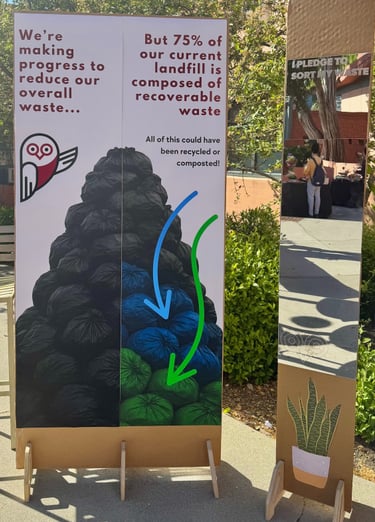
As a part of my role as Zero Waste Designer for Zero Waste at Stanford, I worked with my team to design an installation to encourage correct waste sorting behaviors on campus in pursuit of Stanford's goal of diverting 90% of waste from landfills by 2030.
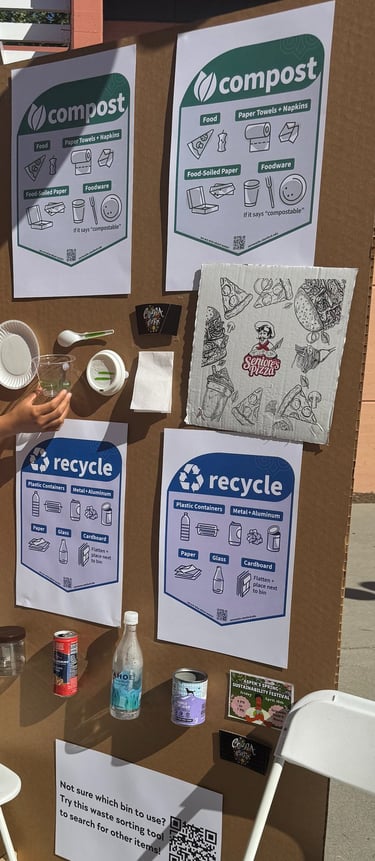
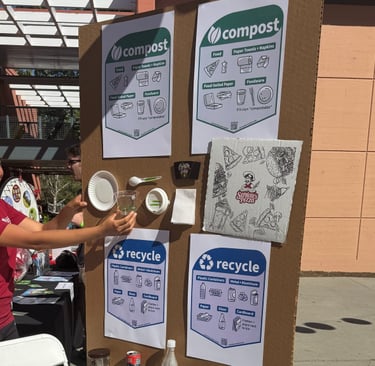
For this event held at an undergraduate residential community, we created an interactive display with three main components directed at different behavior change strategies:
Participating students were asked to pledge to sort their waste and sign their name on a poster signifying their participation along with other students' names.
They then played a game competing with another student to placing velcro trash items on a board correctly identifying compostable and recyclable items.
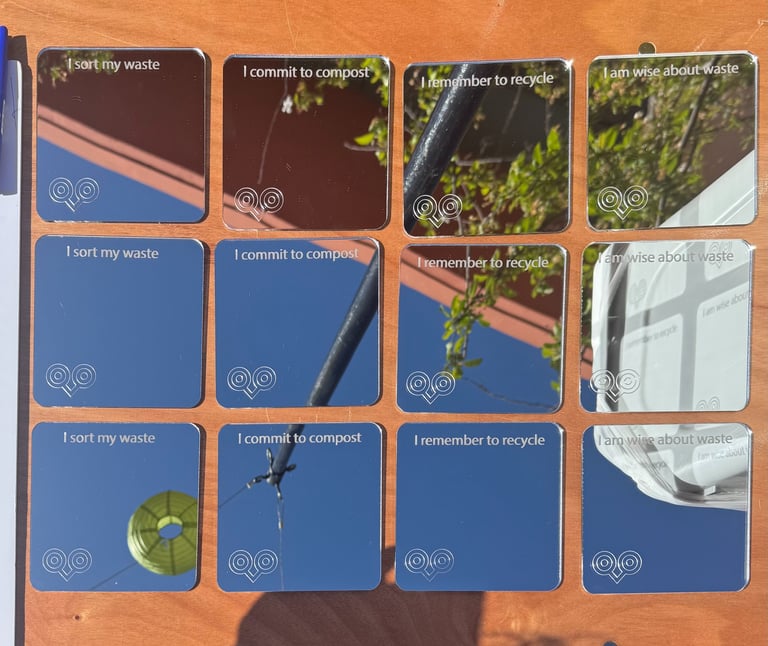
As a prize, they received affirmation mirrors to put in their dorm rooms that were engraved with affirming statements such as "I commit to compost" and "I remember to recycle" to create daily reminders and prompt an identity shift to someone who is wise about their waste.
Lastly, we held a Q&A session answering questions about waste, resolving misconceptions and concerns, and encouraging students that their personal actions indeed made a difference.

